Some people are naturally conversant. They enjoy talking to others and seem to automatically know exactly what to say. Others struggle with conversation, especially with people they don’t know. In my family, there are a couple of each type. Some of the kids are naturally outgoing and feel comfortable walking up to people and starting to talk. The rest of the kids don’t. They struggle with getting the words right, or overcoming shyness to make the effort.
Knowing that being able to converse is an essential life skill, I was thankful for the opportunity to review Color My Conversation from Northern Speech Services. When the box arrived, we all enjoyed opening it up and going through it. As you can see, it contained a lot of goodies!
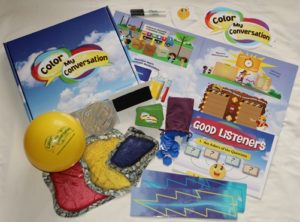
I will say, it was a little overwhelming at first. I was really hoping for a manual I could flip through, but unfortunately it was all on the CD-Rom. That meant I had to go over to the computer to try and figure out what I was supposed to be doing when all the kids were eager to get started. Note to self: Next time open it up and figure it out before showing all the cool stuff to the kids!
After watching a quick training video online, and skimming through the manual on the computer, we jumped right into a yellow conversation.
What’s a Yellow Conversation?
Color My Conversation includes these amazing dry erase friendly colored “stones.” They have a non-skid padding on the back. When placed out on the floor, these stones form the conversation path for us to follow.
Two of these stones are yellow. They form the beginning and end of any conversation.
If you think about the conversations you have with people, they all start and end in a similar manner. We say “Hello.” We say “Goodbye.” So those words are the bookends of our conversations so to speak. In Color My Conversation, those words are the yellow stones.
So the very first lesson is to become comfortable saying hello and goodbye. We brainstormed different words to use, such as “Hey” and “See ya.” We also were able to do some quick chatting about levels of respect in a conversation, and how you’d use different words with friends than you might with an older person at church.
Anyways, we wrote all these different variations of ways to start and end conversations on the yellow stones. Then, we spread them out a wee bit, and practiced having a conversation.
One person stood on the hello stone. They picked a word from the stone and said it to a partner, while holding the conversation ball. Then, they tossed the ball to their partner. When the partner got the ball, that person responded back. Then the ball got tossed back to the person on the stones.
That person then stepped onto the goodbye stone, picked a word and said it to the partner. Then the ball was tossed, and a response given.
So the yellow conversation might look like this:
Person 1: Hello!
Speaker2: Hi!
Person 1: Talk to you later.
Speaker 2: Bye!
It seems simple, but really these stones are the foundation for almost every conversation we’ll ever have.
We practiced, until the kids were easily able to start and end a conversation in a variety of ways.
Moving Beyond Hello and Goodbye
Hello and goodbye might be the foundation for conversations, but they aren’t the only words kids need to be comfortable using. After mastering the Yellow Conversation, we moved onto the Short Conversation.
Here, we add in some small talk. This makes a short conversation perfect for interacting with someone you’ve just met, or talking to friends or relatives. It’s a very versatile conversation!
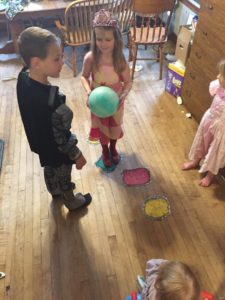
After the short conversation is mastered, the long conversation follows. This conversation introduces topics. They’re different things that the kids could talk about.
Since everyone is interested in slightly different things, these change from person to person. Sometimes you need to provide a bit more background information in your conversation than you do at other times.
The Long Conversation wraps up the beginning portion of Color My Conversation. This program includes everything you need for the beginning, intermediate, advanced, and expert portions. I love how much is included!
While we haven’t yet made it through everything, we will continue working through the lessons. We’re currently working on asking and answering those important WH questions–who, what, when, where, and why.
How We Used the Program
It takes about 45 minutes a week to work through this program using it weekly. There are also some quick practice activities to do throughout the week, which wouldn’t take long if you were using it with only one child. I had three (and sometimes four) kids all wanting to try, so our sessions take longer.
I watched introductory videos online and the ones from the CD-ROM before each session to prepare.
There’s a yellow inflatable ball that comes with the box. If you’re holding the ball you get to talk. Then you toss it to your partner when it’s their turn. This helps children learn the flow of conversations.
But, inflatables don’t work well in our house because of Owen’s pica. He chews on everything he can. So I left that ball in the box, and substituted a more durable ball.
Another portion of the program we didn’t use were the wall hangings. These are really well done, and help serve as a reminder for how conversations can go.
But, I didn’t have the wall space to dedicate to those. So we checked them out and talked about them each session briefly. It wasn’t the same as hanging them up, but it served a similar purpose.
We also just use some of the contents of the box for quick games. For instance, I’d pull out the emotion cards and we’d run through those. We talked about what emotion was shown, and how someone might be feeling if they had that emotion.
We also talked about synonyms for those emotions, and how they were sort of on a continuum. If you were really happy you might say you were ecstatic. If you were less happy it might be glad. There are so many words for similar emotions, so this is helping the kids to see how those words are related.

My Thoughts on Color My Conversation
I had never really thought about the need to break down the ins and outs of a conversation before, but I really see the benefit in doing so. As someone who is more on the introverted side of life, working through this with my kids even helped me to gain confidence.
Initially when I agreed to do this review, I anticipated Owen being able to participate more. But, he would have eaten all the materials. So he just observed.
I did get some inspiration for adding more conversational options to some of the communication apps on his iPad, and finding a way to integrate him more. I’m still mulling that one over, trying to figure out the best way. I know it can be done, I just haven’t figured out the best way to do it yet.
So even if the product didn’t end up being used like I envisioned initially, I’m still very happy with the progress that happened for all of my kids. They all benefited from really analyzing and practicing conversational skills.
I liked that I didn’t have to be an SLP to make the product work. With my background in special education, I have some knowledge of the basics, but the manual contained everything I needed to implement the program.
I’d recommend this product to anyone with kids who need to gain more confidence in their speaking skills. There are definite advantages to learning how a conversation works, and then systematically practicing those components.

Wondering if Color My Conversation by Northern Speech Services is right for your family? You can read additional reviews by clicking on the banner below.